
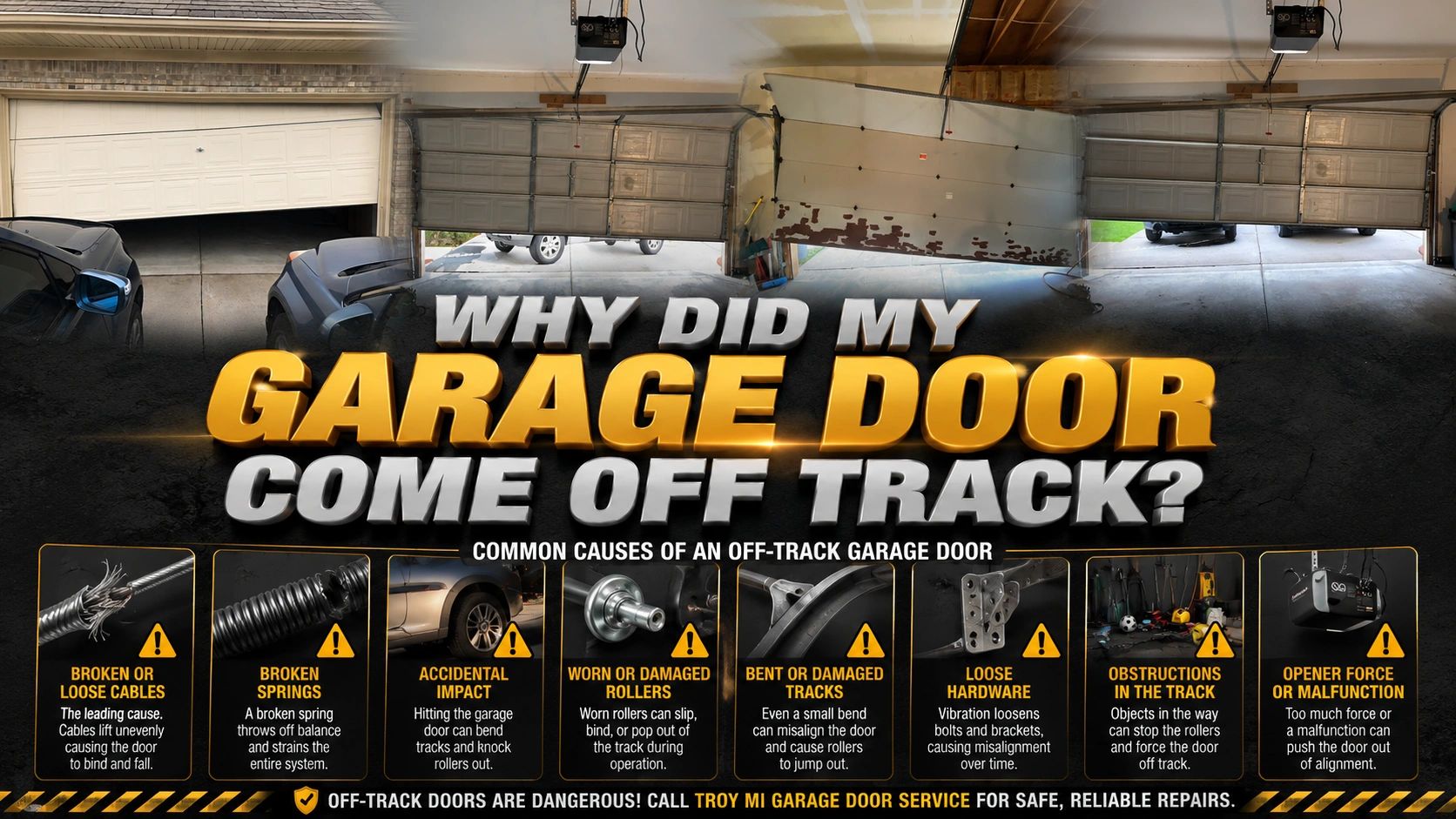
A garage door that has come off its track looks alarming, and it should. One side hangs lower than the other, a roller sticks out past the track, and the opener either strains or stops. Most homeowners want to push the roller back in and move on. Before you do, it helps to understand why it happened, because the roller is rarely the real problem.
How the track, rollers and cables work together
A sectional door rides on rollers that sit inside two steel tracks, one on each side. The vertical track runs up the door jamb; the horizontal track runs back toward the ceiling. The rollers keep the door on its path, but they don't hold it up.
The weight is carried by the springs, which transfer their force through two lift cables. Each cable runs from a bottom bracket at the floor up to a drum on the spring shaft (or over a pulley on extension-spring doors). When both cables carry equal tension, the door stays level and the rollers stay seated. When one side loses tension, that corner drops, the door twists, and the rollers on that side get pulled out of the track.
That's why, in our experience, an off-track door is usually a symptom. The cause is somewhere else in the system.
What knocks a garage door off track
A slack or broken cable. This is the most common cause we find. A cable frays at the bottom bracket, where road salt and moisture attack it, and eventually snaps or unwinds off its drum. One side drops and the door racks sideways.
A broken spring on a two-spring door. When one of two torsion springs breaks, the remaining spring often can't hold the door evenly. Cables go slack and rollers walk out.
Vehicle impact. Backing into a partly open door, or catching the bottom section with a mirror, bends the track or bottom section. Even a light bump can spread the tracks enough for rollers to escape.
Worn or broken rollers. Old steel rollers with seized bearings drag rather than roll. Cracked nylon rollers lose their shape. Either can climb out of the track under load.
Loose or misaligned track. Track brackets anchor into the jamb and ceiling. Vibration loosens lag screws over the years. If the gap between the tracks widens, rollers lose their grip.
Obstructions. A shovel, a kid's toy or a chunk of ice in the lower track can stop one side while the opener keeps pushing the other.
Signs your door is off track (or about to be)
The obvious sign is a roller visibly outside the track. Before that happens, watch for a door that sits unevenly when closed, a gap under one side, rubbing or scraping at one spot in the travel, or an opener that reverses for no clear reason. A cable that looks loose or frayed near the bottom bracket is an early warning. So is a door that shudders at the same point every time.
Stop using the door
If the door is off track, unplug the opener and leave the door where it is. Don't try to close it to secure the garage. A racked door can bind and then release suddenly. Continued operation also bends sections, snaps hinges and can pull a cable fully off its drum.
Keep people and pets clear, especially children, and move vehicles out only if you can do it without touching the door.
Why off-track repair isn't a DIY job
Videos make it look like a matter of prying the track open and tapping the roller back in. The part they leave out is the stored energy. The springs are still under tension, and if a cable is slack, that tension is uneven. Loosening the wrong bracket or bottom fixture can release that energy all at once.
What you can do is look and take note: which side is low, whether a cable hangs loose, whether a spring shows a gap, and whether the track is visibly bent. That information helps a technician arrive prepared.
How we repair an off-track garage door
Every off-track repair starts with securing the door. We clamp it so it can't move, disconnect the opener and inspect both sides before touching anything under tension.
Then we find out why it came off. We check cable condition and seating on both drums, spring condition and balance, bottom brackets for corrosion, rollers and hinges, track alignment and fasteners, and whether any section is bent.
Once the cause is clear, the repair usually follows this order: release or control the spring tension as needed, re-seat or replace the cables, straighten or replace damaged track, replace broken rollers and hinges, and walk the door back into the track. After that we re-tension the springs, check the door for balance by hand, reconnect the opener and adjust its travel and force settings. A final test runs the door several times to confirm it tracks cleanly.
If we only put the rollers back in and leave a frayed cable behind, the door will come off again. Doing the full inspection is what makes the repair last.
Repair or replace?
Most off-track doors are repairable. Replacement starts to make sense when several sections are creased, the door is an older single-layer model that has been damaged before, or parts are no longer available. If a section is kinked, the door may still run, but it will be weaker at that point. We'll show you what we see and give you both options.
Preventing it from happening again
Have cables looked at when the door is serviced, especially near the bottom brackets. Replace rollers when they wobble or grind. Keep the lower track clear of snow, ice and stored items. Pull fully into the garage before closing the door, and watch mirrors and bike racks. If the door starts to look uneven, deal with it early; a cable repair costs less than a cable repair plus track and sections.
Frequently asked questions
Can a garage door come off track on its own? It can seem that way, but something usually caused it: a failing cable, worn rollers, a loose track or a broken spring.
Is it safe to leave my door open until it's fixed? Leave it in place and unplug the opener. Don't force it closed.
Will I need new tracks? Only if they're bent or kinked. Many tracks can be realigned and re-secured.
How long does an off-track repair take? Most are finished in one visit, depending on which parts are damaged.
Get it back on track
If your door is crooked or off its track in Troy, Rochester Hills or nearby, leave it where it is and give us a call. Troy MI Garage Door Service handles off-track, cable and spring repairs, and we'll explain what caused it before we fix it. Call (248) 800-2644.